

Vanonymous
Registered User
- Posts
- 227
- Posts Power
- 227.0%
- Liked
- 42
- Joined
- Jun 22, 2025
- Bonus Points
- 11,200
A recent report, published by the Japanese anti-piracy group Authorized Books of Japan (ABJ), shows that manga piracy is rampant. American pirates, in particular, are a key roadblock in Japan's mission to expand the export of manga and anime. At the same time, American tech companies add to this 'billion dollar' problem.
Japan’s government has never been shy about expanding its “Cool Japan” campaign, in which manga and anime have become increasingly important export products.
According to a new government-backed strategy, Japan aims to quadruple its overseas sales of anime, manga, and video games by 2033.
The goal is to reach 20 trillion yen (~US$133 billion) in overseas sales by 2033. To put that figure in perspective, Japanese officials now explicitly compare this target to the current value of the country’s massive car export industry.
However, before manga and anime can overtake Toyota and Honda, there’s a massive roadblock to pass.
The U.S. Piracy Roadblock
A report on the latest global piracy statistics, released by anti-piracy group Authorized Books of Japan (ABJ) and conducted by Photonic System Solutions, shows that manga piracy sites alone draw 2.85 billion monthly visits globally.
The majority of this traffic goes to English web reading portals, and of all English-speaking countries, the United States is the top consumer of pirated manga, with 317 million monthly visits. That puts the U.S. in third place in terms of global manga piracy consumption, just behind Japan and Indonesia.
American consumers on average have more to spend than their Indonesian counterparts. So it’s safe to say that U.S. piracy is the main concern for Japan’s export ambitions.
What’s equally concerning for publishers is the apparent normalization of online piracy among manga fans. A separate ABJ behavioral survey found that 30% of U.S. manga readers admit to using unauthorized apps or websites to read content.
When asked why, American respondents often mention “saving money” as the primary reason. These manga pirates are not necessarily oblivious to copyright concerns, but the survey suggests that they typically make a calculated financial choice.
The $55 Billion Question
The piracy visits data is based on June 2025 survey data, in which 914 active manga pirate sites were examined. The majority of these (over 90%) were online reading portals, but some direct download and torrent sites were included too.
In an attempt to put a number on the financial damage these sites cause, the report uses a rather basic formula to calculate the estimated losses.
Specifically, the report calculates financial “damage” by taking the time spent on pirate (reading) sites, and multiplying that by the number of mangas that can be read per hour. This figure is then multiplied by the average cost of a manga book: 500 yen (~$3.25).
The Formula: Hours Spent on Pirate Sites × 2 Books × 500 Yen = Financial Damage
The report (translated from Japanese)
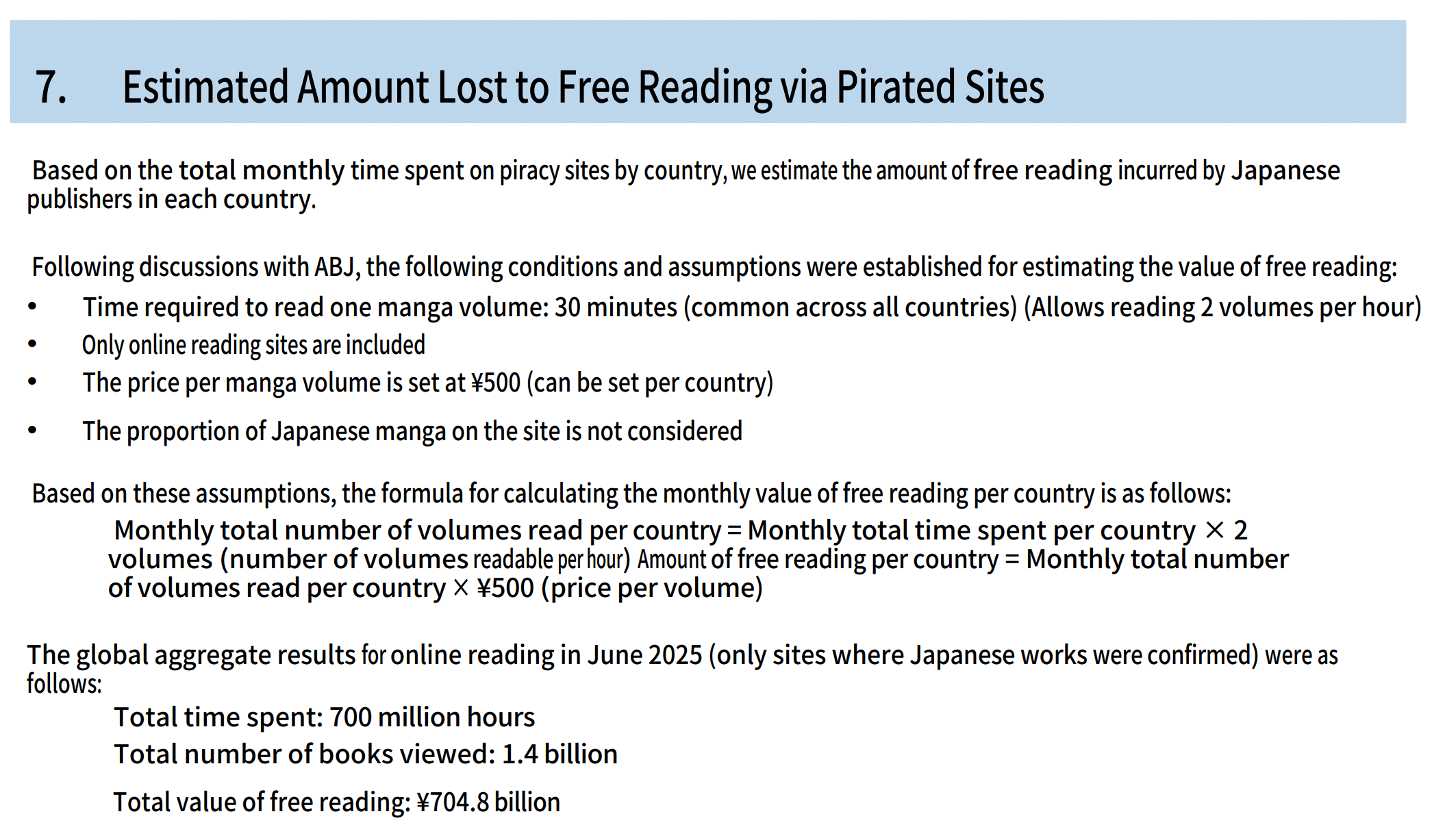
For June 2025, the report calculated that 700 million hours were spent on pirate sites, resulting in a calculated loss of 704.8 billion yen ($4.5 billion) for that single month. That’s $55 billion annually.
This means that manga piracy losses alone exceed piracy damage estimates cited by the movie or music industries, which seems rather high.
This report’s damages calculation relies on the classic and controversial “lost sale” fallacy. It assumes that for every hour spent on a pirate site, a user would have otherwise purchased two manga volumes at full retail price.
In reality, however, there’s no 100% replacement effect. Also, the report does not consider any regional differences, suggesting that piracy in the U.S., Indonesia, and elsewhere is equally damaging.
Regardless of the economic accuracy, the $55 billion damages figure certainly helps to grab the attention of the Japanese authorities, while also increasing the pressure on other rightsholders.
U.S. Piracy Intermediaries?
Not coincidentally, the ABJ report also looked at the domain registrars used by pirate sites. The American company Namecheap came out on top as it’s used by 27% of the sites, followed at a distance by two other U.S. businesses: Namesilo (5%) and GoDaddy (5%).
Similarly, the earlier-mentioned behavioral survey already identified American platforms as a primary gateway for pirate traffic. It listed Google Search as the number one discovery method for pirate sites, while YouTube was ranked second, with nearly half of surveyed users using the video platform to find pirate mangas.
Looking at the front-facing IP-addresses of these sites, Cloudflare was linked to 73% of the sites. While the California company doesn’t necessarily host these sites, it is commonly used as a CDN.
The report doesn’t explicitly state that these intermediaries are liable for pirate sites, but that is ultimately what many rightsholders want.
Last month, Japanese manga publishers Shueisha, Kodansha, Kadokawa, and Shogakukan booked a key success in this regard. The Tokyo court held Cloudflare liable for damages after it failed to sufficiently prevent manga piracy.
In response to that court order, Cloudflare warned that it had “serious implications for the efficiency, security, and reliability of the internet”. However, the publishers clearly disagree, and with billions of dollars of export revenues at stake, they have backing from the government and AI technology.
Japan’s government has never been shy about expanding its “Cool Japan” campaign, in which manga and anime have become increasingly important export products.
According to a new government-backed strategy, Japan aims to quadruple its overseas sales of anime, manga, and video games by 2033.
The goal is to reach 20 trillion yen (~US$133 billion) in overseas sales by 2033. To put that figure in perspective, Japanese officials now explicitly compare this target to the current value of the country’s massive car export industry.
However, before manga and anime can overtake Toyota and Honda, there’s a massive roadblock to pass.
The U.S. Piracy Roadblock
A report on the latest global piracy statistics, released by anti-piracy group Authorized Books of Japan (ABJ) and conducted by Photonic System Solutions, shows that manga piracy sites alone draw 2.85 billion monthly visits globally.
The majority of this traffic goes to English web reading portals, and of all English-speaking countries, the United States is the top consumer of pirated manga, with 317 million monthly visits. That puts the U.S. in third place in terms of global manga piracy consumption, just behind Japan and Indonesia.
American consumers on average have more to spend than their Indonesian counterparts. So it’s safe to say that U.S. piracy is the main concern for Japan’s export ambitions.
| Rank | Country | Total Monthly Visits (Millions) | Share of Global Traffic |
|---|---|---|---|
| 1 | Japan | 390.2 | 13.7% |
| 2 | Indonesia | 327.0 | 11.5% |
| 3 | United States | 317.6 | 11.2% |
| 4 | Thailand | 144.6 | 5.1% |
| 5 | Vietnam | 120.2 | 4.2% |
When asked why, American respondents often mention “saving money” as the primary reason. These manga pirates are not necessarily oblivious to copyright concerns, but the survey suggests that they typically make a calculated financial choice.
The $55 Billion Question
The piracy visits data is based on June 2025 survey data, in which 914 active manga pirate sites were examined. The majority of these (over 90%) were online reading portals, but some direct download and torrent sites were included too.
In an attempt to put a number on the financial damage these sites cause, the report uses a rather basic formula to calculate the estimated losses.
Specifically, the report calculates financial “damage” by taking the time spent on pirate (reading) sites, and multiplying that by the number of mangas that can be read per hour. This figure is then multiplied by the average cost of a manga book: 500 yen (~$3.25).
The Formula: Hours Spent on Pirate Sites × 2 Books × 500 Yen = Financial Damage
The report (translated from Japanese)
For June 2025, the report calculated that 700 million hours were spent on pirate sites, resulting in a calculated loss of 704.8 billion yen ($4.5 billion) for that single month. That’s $55 billion annually.
This means that manga piracy losses alone exceed piracy damage estimates cited by the movie or music industries, which seems rather high.
This report’s damages calculation relies on the classic and controversial “lost sale” fallacy. It assumes that for every hour spent on a pirate site, a user would have otherwise purchased two manga volumes at full retail price.
In reality, however, there’s no 100% replacement effect. Also, the report does not consider any regional differences, suggesting that piracy in the U.S., Indonesia, and elsewhere is equally damaging.
Regardless of the economic accuracy, the $55 billion damages figure certainly helps to grab the attention of the Japanese authorities, while also increasing the pressure on other rightsholders.
U.S. Piracy Intermediaries?
Not coincidentally, the ABJ report also looked at the domain registrars used by pirate sites. The American company Namecheap came out on top as it’s used by 27% of the sites, followed at a distance by two other U.S. businesses: Namesilo (5%) and GoDaddy (5%).
Similarly, the earlier-mentioned behavioral survey already identified American platforms as a primary gateway for pirate traffic. It listed Google Search as the number one discovery method for pirate sites, while YouTube was ranked second, with nearly half of surveyed users using the video platform to find pirate mangas.
Looking at the front-facing IP-addresses of these sites, Cloudflare was linked to 73% of the sites. While the California company doesn’t necessarily host these sites, it is commonly used as a CDN.
The report doesn’t explicitly state that these intermediaries are liable for pirate sites, but that is ultimately what many rightsholders want.
Last month, Japanese manga publishers Shueisha, Kodansha, Kadokawa, and Shogakukan booked a key success in this regard. The Tokyo court held Cloudflare liable for damages after it failed to sufficiently prevent manga piracy.
In response to that court order, Cloudflare warned that it had “serious implications for the efficiency, security, and reliability of the internet”. However, the publishers clearly disagree, and with billions of dollars of export revenues at stake, they have backing from the government and AI technology.