

Vanonymous
Registered User
- Posts
- 235
- Posts Power
- 235.0%
- Liked
- 42
- Joined
- Jun 22, 2025
- Bonus Points
- 11,600
In late May 2025, a Gibraltar-based company asked GoDaddy to deny service to over 100 domains, based on allegations of widespread copyright infringement. A subsequent DMCA subpoena, compelling GoDaddy to disclose the operators' personal details, was challenged by the anonymous operator of two of the domains. With the identities behind 100 domains at stake, an ambitious defense - including a First Amendment component - aimed to keep privacy intact.
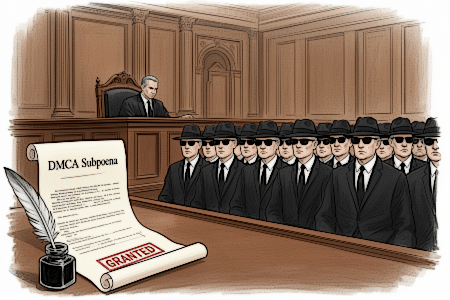
The filing fee for a DMCA subpoena application is just $52.00, so given their potential to expose an alleged infringer’s personal details, they punch well above their weight.
Provided the paperwork is in order, DMCA subpoenas are usually signed off by a court clerk before being served on an intermediary, such as an ISP or web hosting company.
If all goes to plan, the alleged infringer’s details are handed over to the rightsholder in timely fashion and the matter can be considered closed. Even in cases where the stakes are unusually high, DMCA subpoenas are still easy to obtain, but may face additional scrutiny when those affected push back.
100 Infringing Domains
During May 2025, attorneys acting for gaming company Tamaris (Gibraltar) Limited sent a DMCA notice to GoDaddy complaining about more than 100 domain names and associated websites, in some cases also hosted by GoDaddy, reportedly infringing on the company’s intellectual property rights.
Doing business as Pragmatic Play, Tamaris explained that the sites are effectively illegal clones of its own platform, exploiting everything from trademarks and logos, copyright-protected photographs, images and animations, through to the underlying software platform itself. Since GoDaddy had been made aware of the ongoing infringement, Tamaris hoped for decisive action.
“With express notice that a customer has misused your services to conduct activities in violation of the law, and presumably in violation of your Terms of Service, we expect that you are able to make a reasonable determination to deny further services for the Infringing Sites,” Tamaris wrote.
DMCA Subpoena Obtained, Subsequent Motion to Quash
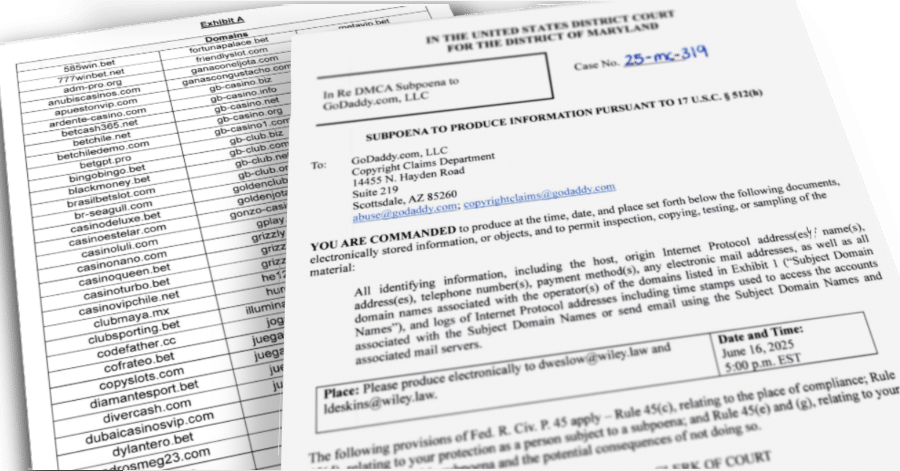
Tamaris obtained a DMCA subpoena from a Maryland district court on June 2, aiming to identify the operators of 104 allegedly-infringing domains. Two months later on August 1, the anonymous operator of two domains appearing on the list filed a motion to quash.
‘John Doe’ said that the subpoena ordered disclosure of highly sensitive, personally identifying information, including names, addresses, telephone numbers, payment details, IP addresses, time stamps and contents of emails. No attempt had been made to contact opposing counsel or identify specific infringement, the motion added.
“The request is overbroad, unsupported by individualized allegations of infringement, and improperly seeks to unmask Movant, who is associated only with two of the multiple listed domains, and others through a mass investigatory request with no judicial oversight,” the motion continued.
Noting that proof to show GoDaddy had even been served was absent from the docket, John Doe argued that a requirement to issue a narrowly targeted DMCA notice in advance of obtaining a subpoena had not been met. Instead, the effort was described as a “phishing expedition” lacking specificity, while exceeding the limited scope of section 512(h) of the DMCA.
“No lawsuit is pending, and the court has not made any determination of good cause or necessity. The absence of pending action weighs heavily in favor of quashing,” the motion continued, adding that disclosure of identity would seriously undermine privacy, especially in the event domains are used for expressive content.
“Courts have long protected anonymous speech from premature unmasking,” John Doe added.
A battle over First Amendment rights would certainly complicate matters, but only in the event the subpoena survived the basics. Focusing on the trademark allegations in the initial complaint to GoDaddy, John Doe’s motion to quash pointed out that since trademarks are not copyright-protected works, a prima facie case of copyright infringement may not have been made out.
Case referred to Chief Magistrate Judge
Tamaris filed its opposition to John Doe’s motion to quash on August 15, providing proof that while GoDaddy had been served in a timely fashion, John Doe’s motion to quash wasn’t timely at all.
Filed way beyond the June 16 return date, the motion failed to satisfy the legal standard, so it should be denied, Tamaris informed the court.
The case was referred to Chief Magistrate Judge Timothy J. Sullivan who weighed arguments from both sides in forming his memorandum opinion handed down on December 11. The Judge wrote that a hearing to determine the outcome of John Doe’s motion would not be necessary.
Memorandum Opinion
Judge Sullivan examined four key disputes before ruling on John Doe’s motion to quash.
Local Rule 104.7 requires counsel to make a “reasonable effort” to resolve discovery disputes. The parties are required to meet in person or otherwise communicate for a reasonable time to demonstrate a good-faith effort to resolve disputes.
Since that didn’t happen, John Doe argued that the DMCA subpoena should be quashed. The Court disagreed. The rule only applies to disputes arising between parties to litigation.
“This is not the case here, as a DMCA subpoena is a prelitigation subpoena designed to facilitate disclosure of identifying information when there is no pending lawsuit,” Judge Sullivan writes.
“The Court is unpersuaded that Movant’s failure to comply with Local Rule 104.7 is a basis to deny the Motion.”
Timeliness of Motion to Dismiss
Judge Sullivan notes that for a motion to quash to be considered ‘timely’, it should be filed prior to the subpoena’s return date. While John Doe’s motion was filed a month after that date, the delay wasn’t his fault.
GoDaddy was served on June 3 and required to produce information by June 16. Yet it took until July 25 to notify John Doe, who then took just five days to file his response on August 1. Since Tamaris wasn’t prejudiced by the delay, the Court excused the motion’s untimeliness.
Scope of DMCA’s Section 512(h)
John Doe’s claim, that the DMCA subpoena exceeded the scope of Section 512(h) by attempting the “mass unmasking” of over 100 domain owners “without an individualized showing of infringement,” was rejected by the Court.
Not only does the DMCA place no limits on the number of identities revealed per subpoena, the Judge explained, there are no requirements for supporting evidence or an individualized showing of infringement. Tamaris’ notification to GoDaddy was sufficient so the DMCA subpoena was issued accordingly.
First Amendment Fails to Protect
John Doe argued that Tamaris’ need for discovery carried less weight than his right under the First Amendment to engage in anonymous speech. Tamaris argued that John Doe’s personal details receive no protection under the First Amendment.
The Court found no guidance on the issue in relevant case law but found various aspects of the case sufficient to reach the following conclusions:
• Tamaris did enough to show a prima facie case of copyright infringement
• The DMCA process is the only means for Tamaris to identify copyright infringers
• The personal information requested by Tamaris was sufficiently specific
• How use of gaming software constitutes expressive conduct was not explained.
• Doe engaged in ‘commercial’ speech with minimal First Amendment protection
• First Amendment can’t be used as cover to infringe intellectual property rights
• When the free speech at issue is alleged copyright infringement, a customer’s privacy interest in contact information associated with an IP address is “minimal at best”
Concluding that John Doe’s identifying information is not a “protected matter” under Rule 45(d)(3)(A)(iii) and with most factors favoring disclosure, John Doe’s motion to quash was denied, bringing the matter to a close.
Judge Sullivan’s Memorandum and Opinion, is available here (pdf)
The filing fee for a DMCA subpoena application is just $52.00, so given their potential to expose an alleged infringer’s personal details, they punch well above their weight.
Provided the paperwork is in order, DMCA subpoenas are usually signed off by a court clerk before being served on an intermediary, such as an ISP or web hosting company.
If all goes to plan, the alleged infringer’s details are handed over to the rightsholder in timely fashion and the matter can be considered closed. Even in cases where the stakes are unusually high, DMCA subpoenas are still easy to obtain, but may face additional scrutiny when those affected push back.
100 Infringing Domains
During May 2025, attorneys acting for gaming company Tamaris (Gibraltar) Limited sent a DMCA notice to GoDaddy complaining about more than 100 domain names and associated websites, in some cases also hosted by GoDaddy, reportedly infringing on the company’s intellectual property rights.
Doing business as Pragmatic Play, Tamaris explained that the sites are effectively illegal clones of its own platform, exploiting everything from trademarks and logos, copyright-protected photographs, images and animations, through to the underlying software platform itself. Since GoDaddy had been made aware of the ongoing infringement, Tamaris hoped for decisive action.
“With express notice that a customer has misused your services to conduct activities in violation of the law, and presumably in violation of your Terms of Service, we expect that you are able to make a reasonable determination to deny further services for the Infringing Sites,” Tamaris wrote.
DMCA Subpoena Obtained, Subsequent Motion to Quash
Tamaris obtained a DMCA subpoena from a Maryland district court on June 2, aiming to identify the operators of 104 allegedly-infringing domains. Two months later on August 1, the anonymous operator of two domains appearing on the list filed a motion to quash.
‘John Doe’ said that the subpoena ordered disclosure of highly sensitive, personally identifying information, including names, addresses, telephone numbers, payment details, IP addresses, time stamps and contents of emails. No attempt had been made to contact opposing counsel or identify specific infringement, the motion added.
“The request is overbroad, unsupported by individualized allegations of infringement, and improperly seeks to unmask Movant, who is associated only with two of the multiple listed domains, and others through a mass investigatory request with no judicial oversight,” the motion continued.
Noting that proof to show GoDaddy had even been served was absent from the docket, John Doe argued that a requirement to issue a narrowly targeted DMCA notice in advance of obtaining a subpoena had not been met. Instead, the effort was described as a “phishing expedition” lacking specificity, while exceeding the limited scope of section 512(h) of the DMCA.
“No lawsuit is pending, and the court has not made any determination of good cause or necessity. The absence of pending action weighs heavily in favor of quashing,” the motion continued, adding that disclosure of identity would seriously undermine privacy, especially in the event domains are used for expressive content.
“Courts have long protected anonymous speech from premature unmasking,” John Doe added.
A battle over First Amendment rights would certainly complicate matters, but only in the event the subpoena survived the basics. Focusing on the trademark allegations in the initial complaint to GoDaddy, John Doe’s motion to quash pointed out that since trademarks are not copyright-protected works, a prima facie case of copyright infringement may not have been made out.
Case referred to Chief Magistrate Judge
Tamaris filed its opposition to John Doe’s motion to quash on August 15, providing proof that while GoDaddy had been served in a timely fashion, John Doe’s motion to quash wasn’t timely at all.
Filed way beyond the June 16 return date, the motion failed to satisfy the legal standard, so it should be denied, Tamaris informed the court.
The case was referred to Chief Magistrate Judge Timothy J. Sullivan who weighed arguments from both sides in forming his memorandum opinion handed down on December 11. The Judge wrote that a hearing to determine the outcome of John Doe’s motion would not be necessary.
Memorandum Opinion
Judge Sullivan examined four key disputes before ruling on John Doe’s motion to quash.
Local Rule 104.7 requires counsel to make a “reasonable effort” to resolve discovery disputes. The parties are required to meet in person or otherwise communicate for a reasonable time to demonstrate a good-faith effort to resolve disputes.
Since that didn’t happen, John Doe argued that the DMCA subpoena should be quashed. The Court disagreed. The rule only applies to disputes arising between parties to litigation.
“This is not the case here, as a DMCA subpoena is a prelitigation subpoena designed to facilitate disclosure of identifying information when there is no pending lawsuit,” Judge Sullivan writes.
“The Court is unpersuaded that Movant’s failure to comply with Local Rule 104.7 is a basis to deny the Motion.”
Timeliness of Motion to Dismiss
Judge Sullivan notes that for a motion to quash to be considered ‘timely’, it should be filed prior to the subpoena’s return date. While John Doe’s motion was filed a month after that date, the delay wasn’t his fault.
GoDaddy was served on June 3 and required to produce information by June 16. Yet it took until July 25 to notify John Doe, who then took just five days to file his response on August 1. Since Tamaris wasn’t prejudiced by the delay, the Court excused the motion’s untimeliness.
Scope of DMCA’s Section 512(h)
John Doe’s claim, that the DMCA subpoena exceeded the scope of Section 512(h) by attempting the “mass unmasking” of over 100 domain owners “without an individualized showing of infringement,” was rejected by the Court.
Not only does the DMCA place no limits on the number of identities revealed per subpoena, the Judge explained, there are no requirements for supporting evidence or an individualized showing of infringement. Tamaris’ notification to GoDaddy was sufficient so the DMCA subpoena was issued accordingly.
First Amendment Fails to Protect
John Doe argued that Tamaris’ need for discovery carried less weight than his right under the First Amendment to engage in anonymous speech. Tamaris argued that John Doe’s personal details receive no protection under the First Amendment.
The Court found no guidance on the issue in relevant case law but found various aspects of the case sufficient to reach the following conclusions:
• Tamaris did enough to show a prima facie case of copyright infringement
• The DMCA process is the only means for Tamaris to identify copyright infringers
• The personal information requested by Tamaris was sufficiently specific
• How use of gaming software constitutes expressive conduct was not explained.
• Doe engaged in ‘commercial’ speech with minimal First Amendment protection
• First Amendment can’t be used as cover to infringe intellectual property rights
• When the free speech at issue is alleged copyright infringement, a customer’s privacy interest in contact information associated with an IP address is “minimal at best”
Concluding that John Doe’s identifying information is not a “protected matter” under Rule 45(d)(3)(A)(iii) and with most factors favoring disclosure, John Doe’s motion to quash was denied, bringing the matter to a close.
Judge Sullivan’s Memorandum and Opinion, is available here (pdf)